Thursday, August 21, 2014

Dungeons and Dragons: Edition Wars


About every decade a new edition of Dungeons and Dragons releases to the public.  Some people love the newest edition, while others complain that it is the worst thing to come to famed tabletop game.  My first experience with Dungeons and Dragons was Bauldur's Gate and Advanced Dungeons and Dragons (AD&D).  I was maybe nine when I first played Dungeons and Dragons and of course my memory is still fuzzy about what had happened outside of being exorbitantly excited and dice rolling. So to be fair, I cannot fully express my adoration for AD&D and Second Edition, but I know more than a handful of people who epitomize Second Edition as being the best set. Truly my infatuation with Dungeons and Dragons began when Third Edition released in 2000.  While Third Edition is a love-hate relationship, some will say that it ruined Dungeons and Dragons, others praise it as the Messiah, it had certainly left a mark on many tables and references.

Third Edition
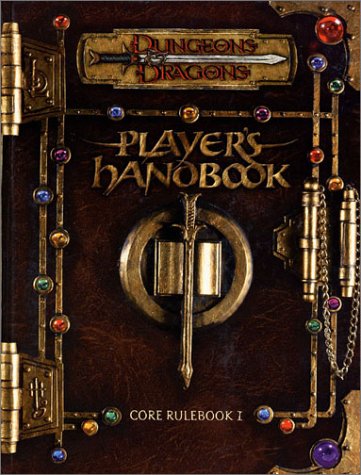

Third Edition had released during the second millennium, we had survived Y2K and my generation didn't really care much about tabletop games.  I on the other hand was pulled into the Fantasy genre thanks to Tolkien, The Hobbit or other assorted Fantasy movies like Conan the Barbarian.  Third Edition had introduced to the system a unified experience chart, diverse classes (some much better than others), feats and skills and simplified saving throws.  Players could rejoice with character specialization through skill points, feat selection and spell selection.  A major problem with the game was the unreadable rules for disarming, tripping, grappling and other rules that extended past "I attack the monster".  Summon spells would also require the spellcaster to have the statblock nearby so they could reference what their summon could and could not do.  Some spells were also labeled as Save vs. Die or Win-Win outcome spells.

Three Point Five


Three years later (2003), we received a rule revision that focused on cleaning up all of Third Edition.  While spellcasters remained extraordinarily strong, other classes that were considered terrible received the Holy Band-aid of Fixing and started to become a viable character choice.  Examples of this are skills being condensed, which allowed Rogues to spend points in "more valuable" areas, Ranger received combat styles, but his hit dice was dropped to D8 and finally the Monk received love to be a playable choice.  Some of the strongest spells in the game were also re-balanced to help maintain a thin guise of balance between casters and martial classes.  This edition still suffered confusing rules when it came to dealing with non-conventional attacks, but it was easily one of the easiest systems to get into as a veteran player.

Three Point Seven-Five
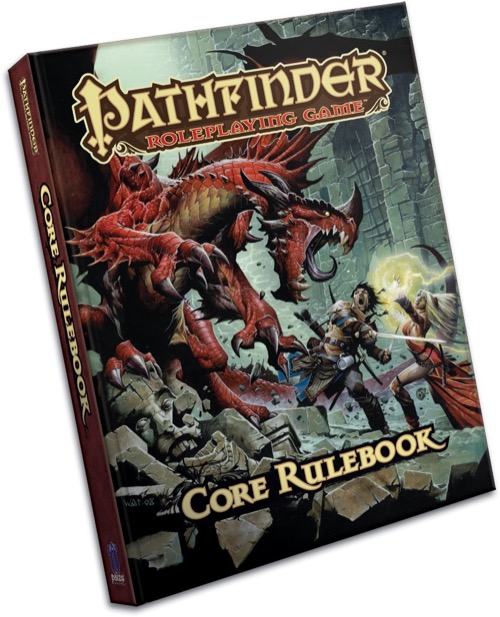

While not technically a Dungeons and Dragons product, through the Open Game License, Paizo was able to produce their own ruleset to the D&D 3.5.  This edition came out in 2009, one year after the release of Fourth Edition with the slogan, "3.5 Thrives!" In this edition Paizo was able to reconstruct some of the most of confusing rules in 3.X such as grappling, tripping and disarming by placing them as a their own singular dice roll "Combat Maneuver Bonus" which is rolled against a target's "Combat Maneuver Defense".  All of the classes were also re-balanced and allowed for greater specialization.  Barbarians now gain rage powers, special abilities that can only be used during their rage, Rogue's gained talents that amplified their class abilities, Sorcerers received bloodlines and the Clerics domains became amazing.  Now to put it simply, the game still works on the foundations of the 3.x universe and if you are familiar with that system, it will be easy to get into this system.

Fourth Edition


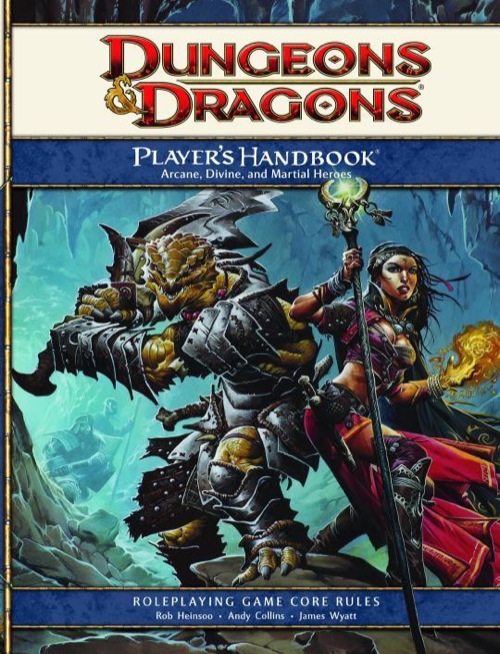
Fourth Edition is World of Warcraft Edition of Dungeons and Dragons.  It was released 2008 with mixed reception. Where prior editions were focused more on roleplaying, Fourth Edition focused dominantly on combat.  The game itself did not focus on the idea of roleplaying, but more about getting more players interested in Dungeons and Dragons.  Characters were separated into different archetypes, I.E. tank, nuker, healer and didn't allow for much focus outside of the combat.  The most interesting thing in this edition was that every class had something to do in combat, everyone felt effective and combat could be very challenging.  While it has a Dungeons and Dragons name going for it, for combat purpose it is one of the best systems for combat.  Combat does not bog down, everyone is useful and everyone has purpose. There are also neat mechanics like pushes and pulls, marking (taunting) and healing for classes that would not normally heal.

Fifth Edition
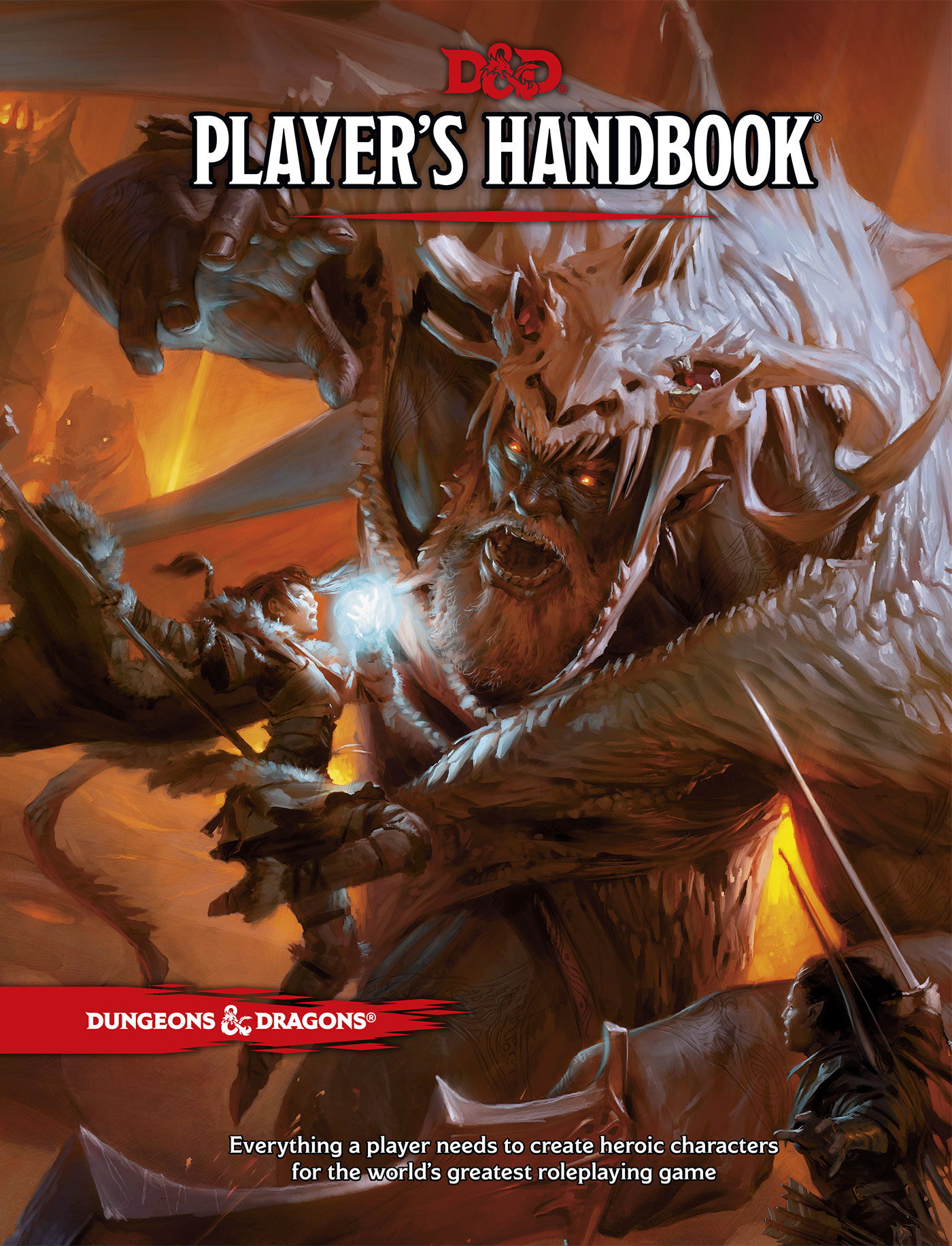

The newest release, which I have yet to play, was released August 2014.  Currently the the only book released in this edition is the Player's Handbook and it certainly does not disappoint.  The top four things that I am impressed with this system are backgrounds, class re-balancing, advantage-disadvantage and inspiration.  The backgrounds do fantastic things for players who are not familiar with Dungeons and Dragons and allows them to randomize their character background.  This background then guides you how you character should be played, the best thing of all is that your DM will reward you with inspiration during an encounter, roleplaying session or even combat.  Inspiration allows you to roll two d20s and take the best of the two.  Advantage and Disadvantage work the same way as inspiration and can happen anywhere.  For example, your character falls down a pit, but is where climbing gear and has a rope, you would have an advantage and would be allowed to roll two d20s.  Fifth Edition or D&D Next is certainly on my list of games to try out, because it brings back the roleplaying aspects of the older editions while keeping the system simple.

Conclusion


All in all, my heart still sits with 3.X and Pathfinder.  Those editions have always been the heart of everything I loved about Dungeons and Dragons and I believe that everyone has their own edition they like.  Some of us might have loved Fourth Edition, others still dwell on their memories of Second and AD&D and remember the days of 18/00 Strength and THAC0.  While we all sit in our dark dungeons, pondering how to escape the lair of liches, dragons and demons we still find hope that our dice will sit at the top 5%.  Do you have an edition you like best?  Leave me a comment and tell us a story about how your edition is the best edition.  

Monday, August 11, 2014

When is it Okay to Metagame


We've all heard it before, and each side of the fence has their own arguments.  In tabletop, especially roleplaying games, it is firmly looked down upon and considered a true anathema to the story, but what if I told you there are ways that you can Metagame in either Dungeons and Dragons and Pathfinder without having your party, Dungeon Master, or real-life players begin to choke you and be considered a good player.  These solutions can be found in core rulebooks.

1.) The Diviner


Divination spells focus dominantly on the principle of detection, identification and location.  The problem comes down to that Divination is not a popular spell line to choose as either a Sorcerer or Wizard, because those classes tend to focus on more combat-utility spells instead of pure utility spells.  This is partially due to the Dungeons and Dragons schema shifting from a "role"-playing experience to "roll"-playing, which was present in 3rd Edition and extended through 4th Edition.  Divination spells inherently are not aggressive in the Arcane spell list, containing spells like Detect Magic, Read Magic, Identify, Detect Thoughts and Clairvoyance.  The strength of the Diviner is that they have immediate reactions that allow you, the player, to gather information quickly about items, locations and people.  With the ability to gather quick information, identify spell effects and auras with little to no effort (Arcane Sight) and spying (Prying Eyes, Arcane Eye). The downside to a Diviner is that you do not have access to real information gathering spells like Augury.  Augury, which will be explained later, allows a player to ask a divine being a yes or no question with varied success. 

2.) Thy Holy Beacon


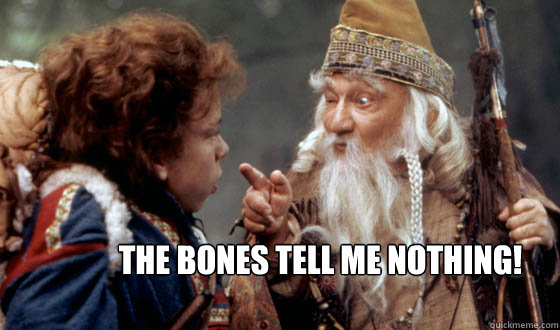
Clerics, unlike Sorcerers and Wizards, can gain information through spells through spells like Augury.  These spells allow the Cleric to gain information about certain actions like: "Are the Bosnians planning to assassinate Archduke Ferdinand?" The answer...nothing.  The cleric would need to cast Commune to find out any information about that question.  Augury on the other hand can be used to justify where to go in an adventure, like posing the question: "Will this path take us to great wealth?" The answer, weal, woe or nothing.  The Augury can also be used to ask about friendship with NPCs: "Does this NPC want to invest in our adventure?" Again, this can be answered with weal, woe or nothing.  Commune does what Augury does, except better and not vague.  Depending on the successful roll, your information comes from different planes or even your deity, that give a certain Yes or No.  If the roll is low, there is a chance you could be lied to, but that is unlikely.

3.) Knowledge, Profession and Craft


Sometimes when your party is drawing straws about how to open a door or get through a puzzle, Knowledge, Profession and Craft checks can sometimes garner information that your character would know.  For example, you are a Fighter who has knowledge Engineering and a former profession in carpentry.  The fighter would certainly be able to figure out how to get a door off hinges with enough time or he might be able to direct the Wizard where to use his Disintegrate spell to the best use.  The fighter would probably also know how well support beams are working in a mine, how to test stones in walls to find a spot.  That would be especially true if he had taken Craft (Stoneworking) creating a synergy of all of his former class knowledges.  This also allows your character to roleplay and "roll"-play, because you had built a backstory where his craft, profession and knowledge are built on synergy.  Another example of this would be a rogue who travels with bards.  The rogue would probably be the pickpocket and wants to be good at hiding his intentions, so he has taken Perform (Comedy) and acts as a clown through a crowd, bumping into them, falling over and quickly stashing their coinpurse.

4.) Gather Information and Learning from NPCs

"Give me your money! My knife is haunted!"

Sometimes you need a spy, sometimes you need a player that can work inside of a network of goons for hours on end and your rogue vocally states that he or she doesn't want to be endangered.  What are you going to do?  Why do you think villains are so great at gaining information?  They hire lower level PCs or NPCs to visit, socialize in areas of high interest and have them return information back to them. A Thieves' Guildmaster might use street urchins and orphans to get information about new pickpockets in town, the Guildmaster might also use one of his lower-tiered associates to become friends with barmaids who then gossip all the good news in hopes of learning about adventurers who had just came back with a huge cache.  Players are also allowed to do this, the problem is, is that it takes time and you have to be able to trust your hireling to do what he was hired to do.

Conclusion

While your party Dungeonmaster may or may not agree, freely metagaming certainly is frowned upon, but you are free to use anything that makes sense to your character and how he or she knows information.  Paladins can detect evil on objects and individuals with varying degrees of success. Wizards can eventually identify an item so well they learn the history of the magical item like who the previous owner was and who made it.  Clerics are essential to the fold, both for their powerful healing spells, buffs and information gathering. Being able to know whether or not to trust an NPC like a king, lord or even the barkeep can be the springboard of a new adventure.  So when you are looking through your spellbooks, remember Wizards, Sorcerers and Clerics, sometimes it is nice knowing something your Dungeon Master didn't want you to know.